After rising from Ottoman rule and the British Mandate, Iraqis were and are still on their quest to achieve both sovereignty over their own land and to have their own welfare upheld, because their country's modern history is marred by conflict, strong influence by foreign powers, and terrorism. Each regime that ruled Iraq had one of the two latter features, or even both. But there is one clear thing: none of which satisfied popular will in the middle of the rule; the Iraqi story has been shaky ever since, to the point of helping mould both global politics and each of the nation's chapters.
We will review three Iraqi regimes, the most significant ones which Iraq is sad to say renowned for.
Rocky road to full sovereignty
Iraq gained full independence in 1932 as a Hashemite kingdom, but it is not without British influence, especially during World War II and the Anglo-Iraqi treaty imposed postwar (1948). Sentiments of anti-Westernism (the Baghdad Pact alliance with West-leaning regimes in Iran, Turkey and Pakistan helped fuel this) and Pan-Arabism (Egypt and Iraq's neighbour Syria formed the United Arab Republic (UAR) in 1958, a factor for increased calls for the pro-West monarchy's dissolution to join it) were on the rise, and this culminated to the 1958 coup (or the 14 July Revolution, coinciding with France's Bastille Day that also celebrates a revolution).
What followed after is a power struggle among Communists, Nasserists (followers of Egypt's Gamal Abdel Nasser, who led the UAR) and Baathists (left-wing Arab nationalists), which led to a series of coups: the Ramadan Revolution in February 1963 by Baathists against Abdul Karim al-Qasim (one of the main putschists of 1958) and Communists (and is thought to have involvement from the United States), another coup nine months later (November) by Nasserists (led by brothers Abdul Salam and Abdul Rahman Arif) against Baathists, and the 17 July Revolution in 1968 by Baathists (while Iraq was still reeling from the loss at the Six-Day War, and as the latter Arif, a moderate, drew the country closer to the West, which the Baathists denounced and thus they drew closer to the Soviet Union and PR China).
Ahmed Hassan al-Bakr took over the Iraqi presidency, and had his cousin Saddam Hussein al-Tikriti as his right-hand man. Saddam then pursued to help improve Iraq and create progressive policies: he wanted to dismantle the divisions between groups like between Sunnis and Shi'as, between Arabs and Kurds, between the elite and the masses; provided free education and healthcare; focused on oil and electric power; and modernised Iraqi agriculture and supported the country's farmers, albeit in a sketchy manner. Saddam then outgrew al-Bakr and gained popularity, and then he started consolidating his power. When al-Bakr was engaging with their fellow Baathist but rival Hafez al-Assad of Syria, Saddam had to call for him to resign. The terror then started.
Saddam
He had strained relations with Syria, and because of al-Bakr's negotiations with Hafez, Saddam must have thought there are traitors in his own party. He then ordered a purge on 01 August 1979, just like what what Hitler, Stalin and Mao did to further establish their rules; it is estimated that hundreds were killed, but the exact toll remains unknown.
He then had nasty relationships with numerous other forces: Saddam espoused a staunch anti-Zionist sentiment even before rising to power; the putschists even killed 14 people, including 9 Iraqi Jews, suspected to be spying for Israel. Saddam, a Sunni, feared that the country's Shi'a-majority population would rebel against him after the 1979 revolution in neighbouring Iran. With the Velayat-e-Faqih regime having sour relations with his, the Iran-Iraq War erupted in September 1980. But he also had poor relations with Kurds in the north-- fellow Sunnis of his, but not Arabs-- and he had been constantly in conflict with Kurdish forces due to his Arabist stance. Iraq's relations with neighbouring countries also deteriorated, and due to Iraq's claims of Kuwait, the tiny Gulf country south of Iraq was invaded, prompting the Gulf War which also involved Saudi Arabia and the West.
His rule was then marked by rampant rights violations. He orchestrated the genocidal Anfal campaign from 1986 to 1989 against Kurds, which killed tens of thousands of Kurdish civilians; one of its worst operations was the Halabja chemical attack which claimed between 3 000 and 5 000 civilian lives, though Saddam's Iranian opponents were suspected to have also participated in the attack. In the wake of Iraq's defeat in the Gulf War, masses then revolted against his Regime in March 1991, showing his vulnerability to collapse. The Regime was successful in thwarting his opposition, and another tens of thousands of casualties added to his record. Mass graves in relation to the rebellion were found around Iraq after his fall, such as one in Karbala and two in the western desert, one in Anbar governorate. Reports of torture and executions were also recorded during his reign.
From a figure widely popular in the country, he then fell deep from the high ravine of hubris as the United States led the invasion in 2003. His popularity faded away as the masses initially celebrated the arrival of the foreigners, threw shoes on his figures, and toppled his statues. Two ex-members of the Iraqi Ba'ath Party, Mohammed Dabdab and Muaz al-Khatib, felt relief upon his judgement after they survived his purge, although they have differing views on his proper fate. Saddam was captured while hiding, was tried, and failed to see 2007 as he was executed on 30 December 2006. It might be worthy to be welcomed, though I never rejoice over deaths of even terrorists and other heinous offenders (I am not supposed to), but what followed was uncertainty.
Crossroads
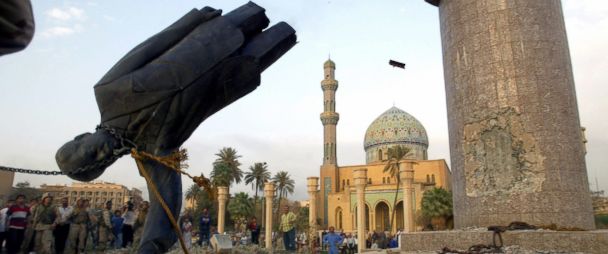
A statue of Saddam Hussein al-Tikriti toppled by civilians after the liberation of Baghdad on 09 April 2003. Gamma-Rapho/Getty Images, via ABC.
After the 9/11 attacks, American president George W. Bush declared a global "War on Terror", mainly focusing on Sunni Islamist groups. Its first major offensive was in Afghanistan, where the leader of the terror attack perpetrator al-Qaeda, Osama bin Laden, was protected by the ruling Islamist regime of the Taliban. With the memories of the Gulf War still fresh to the American administration that is less than a year old, and Saddam's rights violations in Bush' radar, he argued the case for invading the country on the grounds of weapons of mass destruction (WMDs) still stockpiled in the country (these suspicions were raised as the Regime refused to cooperate with the United Nations in inspections to verify the absence of WMDs in the country, which Saddam could have admitted because such weapons were eliminated after the Gulf War, a case where the nothing to hide argument applies), and that there is a relation between the Baathist regime and al-Qaeda (which is ruled out).
Forces of the coalition led by USA started the offensive on 23 March 2003, and the initial phase which ended in the fall of the Baathist regime ran for more than a month (until 01 May). The fall may be a welcoming development for upholding freedom and democracy, but the war which ran until 2011 was never without violations on the part of the Coalition especially of American forces; some of which were the deaths of three journalists in Baghdad, of protesters in Fallujah, the Abu Ghraib prison torture which reduced American credibility, the Mukaradeeb wedding party massacre, the deaths of parents mistaken as suicide bombers in Tal Afar, of 24 civilians in Haditha, the rape-murder case in Mahmudiyah, of 11 civilians in Ishaqi, an airstrike in Baghdad in 2007 that further damaged the Coalition's reputation, and of 17 civilians by the private military company Blackwater (now Academi) (all four perpetrators convicted were pardoned by American president Donald Trump a month before his term ended in January 2021). The role of UK, which is USA's top ally and an influential power in shaping Iraq's modern history, was also scrutinised by the International Criminal Court (ICC) in 2005, though its preliminary examination did not lead to a full-blown investigation due to failure to meet the Court's criteria of gravity of crimes for such investigation.
But what was to shape the near postwar future were the insurgencies the Coalition faced, in three directions: Saddam's loyalists, and Sunni and Shi'a Islamists. We have discussed Baathist terrorism, which Saddamists deny the existence of; the other two will follow. It was not easy for the Coalition to leave Iraq due to these insurgent groups, but all of these are warring against one another, even if the West is their common enemy. This then gave rise to sectarianism in the country, while it was shaken by years of suicide bombings that killed thousands of civilians (when I was a child, my impression about the country was it was full of these attacks). This sectarianism was worsened when the replacing Iraqi regime established was majoritarian-- mainly Shi'a, ruled by Nouri al-Maliki of the Khomeinist Islamic Da'wa Party, who refused to address Sunni demands. Militia groups like the Badr Organisation, the Peace Companies (Sarayat as-Salam) by populist cleric Muqtada as-Sadr, the Kata'ib Hezbollah and the Asa'ib Ahl al-Haq sprouted and began to make influence on the nation; some of which like Badr and Sarayat are known to have death squads. But they did not rule over Iraq immediately, because an impediment that also shaped global politics emerged.
Islamic State
Abu Musab az-Zarqawi of the Jama'at at-Tawhid wa al-Jihad exploited the 2003 Invasion, and the authorities in Syria, led by Hafez' son Bashar, opened an opportunity in 2002 for his group to grow (read more here about relations between the Syrian Baathist regime and Zarqawi's group), and when the Invasion was becoming imminent, Islamist fighters from Syria amassed to Iraq, under Zarqawi's greenlight, to confront the Coalition. The group then pledged allegiance to bin Laden and it became al-Qaeda in Iraq, and later the Islamic State of Iraq group, after Zarqawi's death.
Observing an unstable situation in Syria, the group later led by Abu Bakr al-Baghdadi joined the escalating conflict, siding with fellow Salafi-Wahhabists which supposedly oppose Bashar's regime, notably the Jabhat an-Nusra (now part of the Hay'at Tahrir ash-Sham (HTS)). Al-Baghdadi desired unity among all Salafi-Wahhabi Islamist groups to create one global Islamic State, so he encouraged al-Nusra leader Abu Muhammad al-Julani and bin Laden's successor Ayman az-Zawahiri to join him, only to be rejected by both jihadi leaders, yet al-Baghdadi proceeded with his plans for a caliphate, by starting with conquering lands controlled by Assad's opposition in eastern regions like Raqqa, Deir ez-Zor and the eastern portion of Homs.
Meanwhile in Iraq, Sunnis protested against Maliki's sectarian Shi'a regime in 2012, but the latter treated them with repression, and this became the impetus for both Iraqi Baathists (like the Naqshabandi Army) and the Islamic State in Iraq and the Levant to flourish as they gained popularity from parts of the disgruntled Sunnis; some of such Baathists, even high-profile figures in Saddam's regime, joined the jihadist group; their presence in its system may have helped construct a complex Islamist regime that was to be accomplished after it started its campaign after the December 2013 protest clashes with the Maliki regime. Fallujah in western Iraq was one of their first prizes after it fell the following month. What was to become the "Islamic State" (IS) group later forced Baathists to join it or face death.
I will be discussing less of the known atrocities of the IS tyranny such as the genocide against non-Muslim Yazidis in Sinjar, the Camp Speicher massacre (both of which had thousands killed), religious intolerance, and attacks against women's rights. The IS established a totalitarian dictatorship, and dissent is suppressed yet not absent. It is given anti-IS activism is alive in Syria as it roots from anti-Assad activism (such as the citizen journalist group Raqqa is Being Slaughtered Silently (RBSS; the film City of Ghosts gives an overview of it)), but in the IS-held Iraqi territories, dissent is less known in the face of the international community. Nevertheless, even Sunni civilians who lived in the Baghdadi regime's rule were defiant, even if expressing their opposition in small manners.
Maliki's successor, Haider al-Abadi took note of the Shi'a militia groups and consolidated them into one-- the Hashd ash-Sha'bi (or Popular Mobilisation Forces (PMF)). It became a national instrument in defeating the IS group with the help of the anti-IS Coaliton (CJTF-OIR) and Iran, and this time it rose into some degree of popularity, yet it didn't gain approval from masses in general. A demand from Iraq's top Shi'a cleric, Ayatollah Ali as-Sistani, called for the integration of the PMF into the country's armed forces, and so it began in late 2017.
But it would also then become an instrument for suppressing the later protests that still run until now.
Hashd
National unity is a wish among the Iraqi masses, and they face the same nature of problems: scarcity in water and electricity, rising unemployment rates, rampant corruption, and the presence of foreign troops. Since the fall of Saddam's dictatorship, foreign forces have leverage in the succeeding regimes, and Iran's Velayat-e-Faqih regime is the lucky one: PMF is its proxy, and upon the establishment of a new Iraqi government, someone supportive for the Iranian mullahs gets the position of Prime Minister. The 2012-13 protests displayed discontent among the Sunnis, but in 2019, both peoples are furious, although it is the Shi'as who initiated it (there were protests in 2018 which were also of significance but had a smaller scale).
It was also joined by the Sadrists (followers of Muqtada as-Sadr) in the protests' early weeks, but the assassination of Qassem Soleimani of Iran's Quds Force and Abu Mahdi al-Muhandis of Kata'ib Hezbollah by an American drone became a litmus test of the protesters' integrity: Sadrists distanced themselves from genuine protesters, the latter calling for better quality of life, transparency, democracy, secularism and sustainable peace, and the spotlight from the international community turned away from them.
It later became increasingly difficult for Iraqi civilians to dissent; the phantom of Saddam and IS is in its new shape, which is the PMF. Death squads linked thereto are still alive, and activists like Ehab al-Wazni and journalists like Ahmed Hassan were targetted. Disappearances of prominent individuals like activist Ali Jasb al-Hattoub and events organiser Arshad Fakhry were reported. There are at least 82 reports of dissidents killed by the PMF, among hundreds of all other civilians killed by the Regime's repression.
The protests may have born some fruit: Abadi's pro-Iranian mullahs successor, Adil Abdul-Mahdi, resigned and was replaced by Mustafa al-Kadhimi. He promised to bring justice against perpetrators, but he can't get rid of sticking to the Velayat-e-Faqih regime, nor does he undo Abadi's integration of the PMF to the armed forces. A significant development was the arrest of the high-profile PMF official Qasim Muslih in May 2021 on charges of terrorism, but he was released days later after demonstrations from PMF supporters. It showed the whole system is rotten, something the Iraqi masses demand to be overhauled.
In every chapter of Iraq's modern history, previous dictatorial forces and circumstances paved way for new ones: Saddam, being inconsiderate to Shi'as, passed the throne to those backing the Iranian mullahs, a major enemy of his. Maliki, being inconsiderate to Sunnis, helped shake global politics by giving way for the IS group. Saddam's loyalists then aided the Sunni Islamist regime, only to be betrayed; they may have been victims thereof, but they helped created a giant monster, so they shall share blame. Abadi, wishing to strike the IS group, also developed another giant monster, and it now corrodes the already-tarnished Iraqi system.
None of these forces ever upheld sovereignty by the masses nor their welfare at the same time. The populace's reaction: boycott the upcoming elections (or "elections") on 10 October 2021. Iraqis only had terror regimes reigning over their land in their modern history, something much of the world does not know about. It's time for the international community to give tangible support to the October Revolution.
Article posted on 02 October 2021, 00:42 (UTC +08:00).


 WordPress.com


No comments:
Post a Comment