Biliran: Island Visit with Ormoc and Tacloban Sidetrips
Down with my last 3 island provinces left to visit, I used my Cebpasses (roundtrip) to visit this island on weekends since I don't have much leave credits yet. One attraction comes to my mind when thinking of Biliran: Sambawan Island. So I scoured the t…
Down with my last 3 island provinces left to visit, I used my Cebpasses (roundtrip) to visit this island on weekends since I don't have much leave credits yet. One attraction comes to my mind when thinking of Biliran: Sambawan Island. So I scoured the travel tips left by fellow backpackers in that Facebook travel page and inquired. Hence, my first domestic flight this year.
The Visayas, or the Visayan Islands (Visayan: Kabisay-an; Filipino: Kabisayaan, are one of the three principal geographical divisions of the Philippines, along with Luzon and Mindanao. Located in the central part of the archipelago, it consists of several islands, primarily surrounding the Visayan Sea, although the Visayas are also considered the northeast extremity of the entire Sulu Sea. Its inhabitants are predominantly the Visayan peoples.
Eastern Visayas (Waray: Sinirangan Kabisay-an; Cebuano: Sidlakang Kabisay-an; Tagalog: Silangang Kabisayaan or Silangang Visayas) is an administrative region in the Philippines, designated as Region VIII. It consists of three main islands, Samar, Leyte and Biliran. The region has six provinces, one independent city and one highly urbanized city namely, Biliran, Leyte, Northern Samar, Samar, Eastern Samar, Southern Leyte, Ormoc and Tacloban. The highly urbanized city of Tacloban is the sole regional center. These provinces and cities occupy the easternmost islands of the Visayas group of islands. Eastern Visayas faces the Philippine Sea to the east. The region's most famous landmark is the San Juanico Bridge, which links the provinces of Samar and Leyte.
Working at Makati a day before my trip, I went back to my dorm to change and pick up my backpack. Since it's an early morning flight, I took Grab from here to NAIA Terminal 3 and waited few hours before departure. Time to tick my 79th province as part of my #project81.
Presenting my itinerary map above of Eastern Visayas, with arrival at Tacloban City airport, travel to island province of Biliran, Kawayan Port for island trip at Sambawan Island, day trip at Ormoc City, back to downtown Tacloban and departure at same airport.
HIGHLIGHTS PER REGION:
EASTERN VISAYAS designated as Region VIII Province of Biliran where the capital is the Municipality of Naval 📍Provincial Capitol of Biliran 📍Our Lady of the Holy Rosary Cathedral 📍Naval Municipal Hall 📍Naval People's Park 📍Biliran Province State University 📍Sambawan Island (Municipality of Maripipi) 📍Ulan-Ulan Falls (Municipality of Almeria) 📍Tinago Falls (Municipality of Caibiran) 📍Higatangan Island and Sandbar (Municipality of Naval)
Ormoc City officially the City of Ormoc, a 1st class independent component city 📍New Ormoc City Hall 📍Saints Peter and Paul Parish Church 📍Ormoc City Heritage Museum (Old City Hall) 📍Ormoc City Park 📍Battle of Ormoc Bay Historical Marker and Park 📍Ormoc City Port 📍Western Leyte Guerilla Warfare Forces Monument 📍Puente de la Reina - city's oldest bridge 📍Ormoc City Pasalubong Center for queen pineapples, souvenirs and other delicacies
Tacloban City officially the City of Tacloban, a highly urbanized city 📍Provincial Capitol of Leyte 📍Archdiocesan Shrine of Santo Niño Parish Church 📍Tacloban City Hall 📍Santo Niño Shrine and Heritage Museum 📍Rizal Plaza 📍Price Mansion 📍M/V Eva Jocelyn Shrine 📍Kanhuraw Hill 📍Joedy's Pasalubong and other stores at Zamora St for Leyte delicacies such as sagmani, moron, binagol, etc.
Daniel Z. Romualdez Airport (IATA: TAC, ICAO: RPVA), also known as Tacloban City Airport, is an airport serving the general area of Tacloban, a highly urbanized city in the Leyte island of the Philippines. It is the main gateway from Manila and Cebu to Eastern Visayas. It is classified as a Class 1 principal (major domestic) airport by the Civil Aviation Authority of the Philippines.
Biliran, officially the Province of Biliran (Waray-Waray: Probinsya han Biliran; Cebuano: Lalawigan sa Biliran; Tagalog: Lalawigan ng Biliran), is an island province in the Philippines located in the Eastern Visayas region (Region VIII). Biliran is one of the country's smallest and newest provinces. Formerly a sub-province of Leyte, it became an independent province in 1992. The present name, believed to be adopted sometime between the late 17th century and the early 18th century, was, according to many publications, derived from a native grass called borobiliran which once grew abundantly on the island's plains. A contending theory states that the name came from the word bilir, which was defined in an old Visayan dictionary to be the "corner or edge of a boat, vase or anything protruding, like veins, or the furrow made by the plow." Biliran lies less than a kilometer north of the island of Leyte. A bridge-causeway fixed link over Poro Island in the gateway town of Biliran connects the province to Leyte. Its capital is the municipality of Naval on the western coast of the island. My 79th province!
Naval, officially the Municipality of Naval (Waray: Bungto han Naval; Cebuano: Lungsod sa Naval; Tagalog: Bayan ng Naval), is a 2nd class municipality and capital of the province of Biliran, Philippines. The town of Naval was once named Bagazumbol, which was perceived by natives as being too warlike a description. The aboriginal name was later modified in 1859 to a more peaceful name—the presently known Naval. On September 26, 1869, Naval was officially established and recognized as an independent pueblo.
The Roman Catholic Diocese of Naval (Lat: Dioecesis Navaliensis) is a diocese of the Roman Rite of the Latin Church of the Catholic Church in the Philippines. Its cathedral is in Naval, Biliran in the Eastern Visayas. Its territory includes whole island of Biliran and the northwestern tip of Leyte Province. Erected in 1988, the diocese was created from territory of the Roman Catholic Archdiocese of Palo, to which the diocese remains a suffragan.
The Our Lady of the Most Holy Rosary Cathedral Parish (Filipino: Parokyang Katedral ng Mahal na Birhen ng Kasanto-santuhang Rosaryo), commonly known as Naval Cathedral (Filipino: Katedral ng Naval), is a 20th-century church building of the Roman Catholic Church in the municipality of Naval, Biliran, Philippines. It is the cathedral of the Roman Catholic Diocese of Naval.
Maripipi, officially the Municipality of Maripipi (Waray: Bungto san Maripipi; Cebuano: Lungsod sa Maripipi; Tagalog: Bayan ng Maripipi), is a 5th class municipality in the province of Biliran, Philippines. The town's populace predominantly speak Waray language. Maripipi Municipality is composed of Maripipi Island and surrounding islets situated northwest off the coast of Biliran Island. Mount Maripipi is the highest point in the island with an elevation of 3,031 ft (924 m) above sea level.
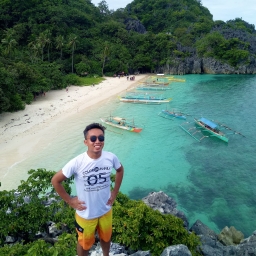
Sambawan Island is the name of an island in the province of Biliran in the Philippines. It is found about five (5) kilometers west of the coast of the island of Maripipi, in the southern Samar Sea. Here the island is cultivated and taken care of by the people of Maripipi.
Sambawan Island was created by tectonic forces and it looks like a sickle. At low tide, the island reached its highest point, reaching twenty (20) meters above sea level. At high tide, the island splits three times. The beach is rugged and has high rocks. The water that surrounds the island is advertised as a dive site by the Biliran Provincial Tourist Board, because of the weeds and algae that surround the island.
Ormoc, officially the City of Ormoc (Cebuano: Dakbayan sa Ormoc; Waray: Syudad han Ormoc; Filipino: Lungsod ng Ormoc), is a 1st class independent component city in the Eastern Visayas region of the Philippines. Ormoc is the economic, cultural, commercial and transportation hub of western Leyte. The city's name is derived from ogmok, an archaic Visayan term for "lowland" or "depressed plain". The city also celebrates an annual thanksgiving festival called the Piña Festival in honor of the saints Peter and Paul in thanks for the bountiful pineapple harvest.
Queen Pineapple The Pride of Ormoc City is Among the Sweetest in the World. The "Queen Pineapple" is often referred to as the dwarf pineapple due to its size which is between 500 grams to 700 grams. The exterior is rough and thorny, yet very sweet and succulent on the inside. It is best eaten fresh as it is not ideal for canning. Ormoc produces roughly 100 tons per year. Not enough to supply the growing local demand for their pineapples.
Centennial Park The Veteran's Park was constructed in early 1990s in honor of the Filipino soldiers who fought for the liberation of Leyte and the Philippines. The Centennial Marker was erected in 1998 to commemorate the 100th year of Philippine independence.The park is located in the city, it is a leisure and picnic ground for the young and old alike.
Western Leyte Guerrilla Warfare Forces Monument The Monument commemorates the Filipino resistance fighters who fought in the guerilla war against the Japanese occupiers in the Second World War.
Ormoc City Plaza
Puente dela Reina Known as the oldest bridge in the city. Its cobblestones still intact, relic of an age long gone. It was built in the early 1800s but was completed in 1861. In Spanish era, the bridge was used as docking area for sailboats, vintas of Chinese, Javans and Indonesians who frequented the island to sell their produce. The bridge is still in use to this day.
Ormoc Museum Just as Ormoc City is known to be one of the country's most progressive and safest cities, it's also a City that has not forgotten its roots in the rehabilitation of the Old Ormoc City Hall and transformed it into a functional City Museum that showcases the rich history and artistry of every Ormocanon. The Museum was officially opened on October 20, 2019 together with the Ormoc City 72nd Charter Day celebration. It houses different kinds of paintings, photographs, sculptures, artifacts, documents and books. It is now considered as an artists haven where every Ormocanon and its visitors have had the chance to witness the long-hidden treasure of Ormoc and to learn and gain insights on the preserved culture and history of the city. The second floor of the Museum houses more art pieces of some notable artists in the country like Benedicto Cabrera. This is one of the best city museums I've visited. It reminds me of Sorsogon Provincial Museum that used to be a prison.
Saints Peter and Paul Church is a Roman Catholic church located in Aviles Street, Ormoc City, Leyte. The church is built in a cruciform shape. Over the entrance is an overhang marked with the words, Porta Sancta (Holy Door), and it is flanked by the statues of St. Peter and St. Paul. Above are a cross and the images of the Sacred Heart of Jesus and Immaculate Heart of Mary on stained glass. The rest of the facade is lightly adorned by arches, recessed wall surfaces, and arch windows. In the gospel side are the six-bodied bell tower and the chapel for votive candles (dagkutanan).
Tacloban, officially the City of Tacloban (Waray: Syudad han Tacloban; Filipino: Lungsod ng Tacloban), is highly urbanized city on Leyte island in the Eastern Visayas region of the Philippines. The city is autonomous from the province of Leyte, although it serves as its provincial capital. Tacloban is the most populous city in the Eastern Visayas. The city is located 360 miles (580 km) southeast from Manila. The place got its name from the word taklub, a bamboo tray used to catch crabs or shrimp.
The Archdiocesan Shrine of Santo Niño, also known as the Santo Niño Church, is a Roman Catholic church in Tacloban, Philippines. The Santo Niño Parish Church was founded in 1770 by the Augustinian. Its namesake, the Santo Niño would be attributed to the end of a cholera epidemic in 1889. The arrival of the image of the child Jesus Christ in the Port of Tacloban, which was previously believed to be lost at sea, on June 30, 1889, was credited to have caused a miracle ending the outbreak. On November 1, 2021, amidst the COVID-19 pandemic, the church was elevated to an archdiocesan shrine from a parish.
Late lunch at Sal's. It's a coincidence that this is the same name as pineapple stall in Ormoc City...hehe Sal's Restaurant 163 Salazar St, Downtown, Tacloban City, Leyte
Zamora Street Pasalubong Center This street near Tacloban Port is where you can buy Leyte and Samar delicacies such as sagmani, moron and binagol. (n_n)
390.88 MNL-TAC Cebpass Voucher
634.56 Add-on for booking MNL-TAC flight
390.88 TAC-MNL Cebpass Voucher
599.56 Add-on for booking MNL-TAC flight
22 Jeep TAC Airport to Downtown Van Van's Terminal
200 Van Tacloban-Naval ETD636am ETA914am
1000 Boat Roundtrip Kawayan Port-Sambawan (chance passenger on a privately-hired boat by Kuya Johndave 09655574615)
125 Sambawan Entrance Fee (100) and Environmental Fee (25)
600 Habal-habal roundtrip Naval-Kawayan Port (Kuya Joery Catigbe in Facebook is my initial contact but I didn't get early to his day tour that time so he asked Kuya Sadam to fetch me at Naval and bring me to Kawayan port and fetch back to Naval. I initially planned to have waterfalls tour after Sambawan but unfortunately, I slipped on a cemented stairway from Sambawan viewpoint so I got bruises on my right knee and left ankle. I can't barely walk then so I decided not to push the waterfalls tour. Instead I went back to my hotel in Naval to treat my wounds and rest).
499.36 Hotel Benjamin Naval 2D1N Single AC Room with CR booked via Agoda
15 Trike Biliran capitol to Naval cathedral
200 Van Van's Naval-Lemon Crossing 844am ETA950am (No van going to Ormoc that day so I opted cutting trip to Lemon crossing. From Lemon crossing, wait for van, ejeep or bus to Ormoc).
140 Van Lemon Crossing-Ormoc 959am-1051am
10 trike New Ormoc City Hall to downtown
200 Van Van's Ormoc-Tacloban ETD130pm ETA340pm
22 Jeep Tacloban downtown to airport
TOTAL EXPENSES (EXCLUDING FOOD and PASALUBONG) = Php5049.04


No comments:
Post a Comment